Hui Waʻa Kaukahi

Nui a lehulehu na mokupuni, ʻaʻole lawa ka manawa

So many islands, so little time!

Category: Paddles

  • Planes, Kayaks and Automobiles

    Planes, Kayaks and Automobiles

    Story and photos by Amy Fujimoto

    January 25, 2026

    We met early at the Sand Island Boat Launch Facility — Bill (our paddle leader), myself, Debi, Miki, and Stan — and immediately began the logistical dance that comes with a one-way paddle. Bill and I drove our cars to the landing point at Puʻuloa Beach Park at the end of Fort Weaver Road, while Stan kindly chauffeured us back to Sand Island. By the time we returned, Debi and Miki were ready to paddle. Sandy joined us for the start, paddling with us through Keʻehi Lagoon and part of the runway before turning back, so most of the day’s adventure belonged to the five of us.

    Selfie of a woman with five kayaks on the beach behind her
    Author’s selfie at launch

    It turned out to be a great paddle. The water was incredibly flat and glassy, even once we were out in the open ocean. Bill commented that this was the flattest he’d ever seen, which was especially good news for Miki and me since we were in for an eight-mile day.

    The clear water made the paddle even more special. We could see tiny reef fish weaving through the coral below us, and several turtles surfaced nearby for quick breaths before slipping back under. One unforgettable moment came when we spotted what we thought was either rubbish or floating, lifeless turtle — only to discover it was actually a Hawaiian monk seal enjoying a lazy rest. It eventually woke up, swam a couple of curious circles around Bill’s kayak, and then disappeared quietly into the depths.

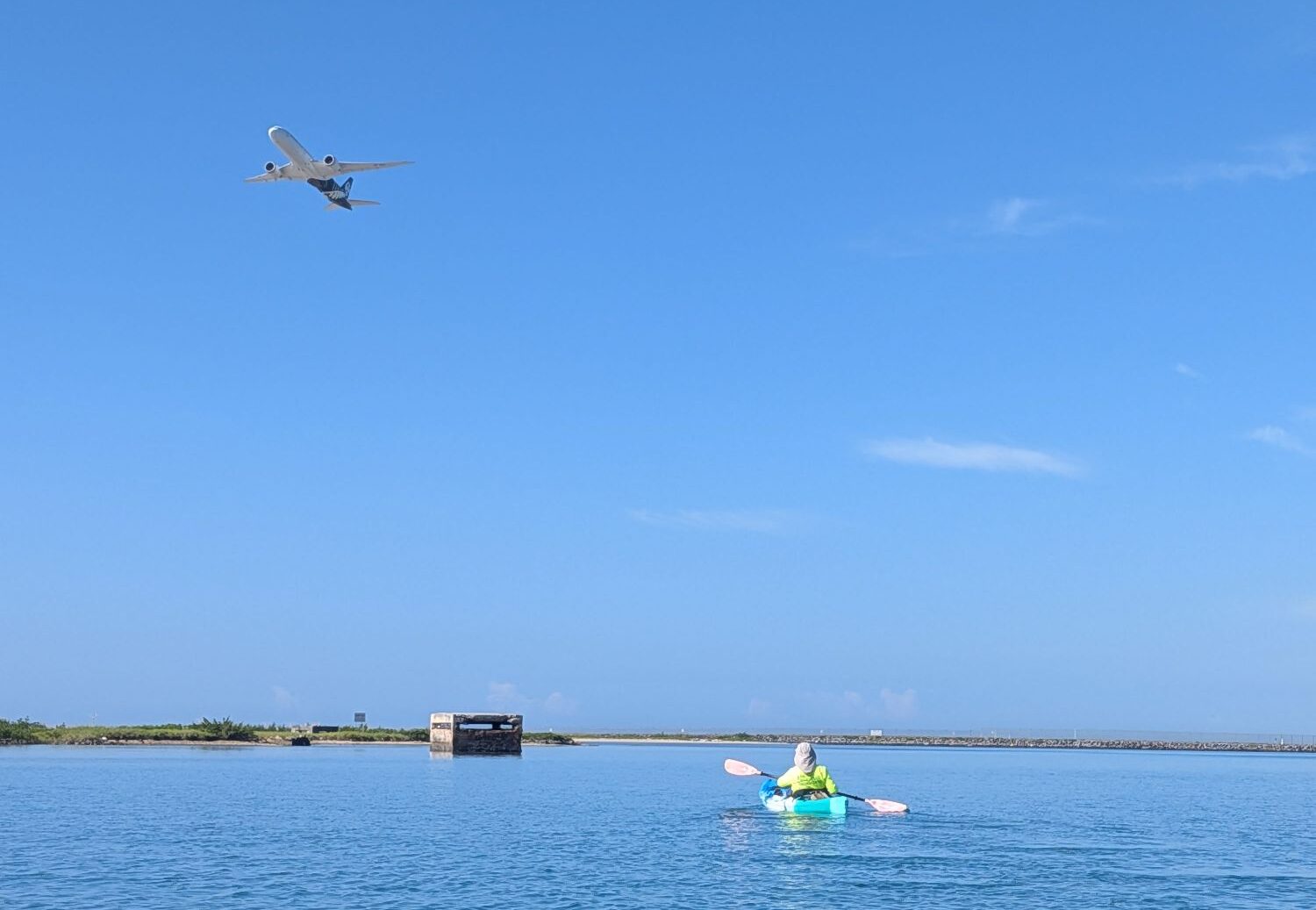
    Kayakers with HAL jet gaining altitude
    Calm clear water

    One of the most unique parts of this route is that you paddle along the entire length of the runway. Planes were constantly gliding in over our heads to land or roaring off beside us, all in perfect, orderly rhythm. Up close, the long wall beside the runway slowly changes from rock to massive dolos blocks, which is surprisingly interesting to see from the water.

    Two kayakers in front of the reef runway dolo blocks
    The dolo blocks weren’t needed on this calm day
    Two kayakers paddling past dolo blocks fronting the airport reef runway
    Dolo block abstract artwork

    Once we passed the runway and neared the Pearl Harbor access channel, the waves and wind picked up a little, but it was still very manageable. We stayed well clear of Pearl Harbor and the firing range — definitely not a place you want to wander into — and before long we were lined up with Puʻuloa Beach Park. From there it was a straight shot in, with the occasional wave giving us a gentle push toward shore.

    Getting back on our land legs turned out to be the hardest part of the day. We were all a bit wobbly, and the deep sand didn’t make things any easier. Dragging our kayaks up the steep beach took some effort, but we were able to rinse the sand off our kayaks and wheel them back to the cars in good time.

    The highlight on land was watching Bill work his magic loading four kayaks onto the top of his car. It earned him a well-deserved round of applause — and a commemorative photo — before we all headed our separate ways.

    Man tying down one of many straps around a roof topped kayak
    Bill advertises Go Bananas straps
    Two women steady a fourth kayak on a roof rack
    Kayak #4 going on Bill’s car

    It was a very successful paddle and a truly unique one. I’d highly recommend this route when it comes around again, especially if we’re lucky enough to get water as calm and beautiful as we had on this day.
  • Wolf Moon Paddle

    Wolf Moon Paddle

    Story by Sarah Schlehr

    Cover photo by Sandy, others as noted

    January 3, 2026

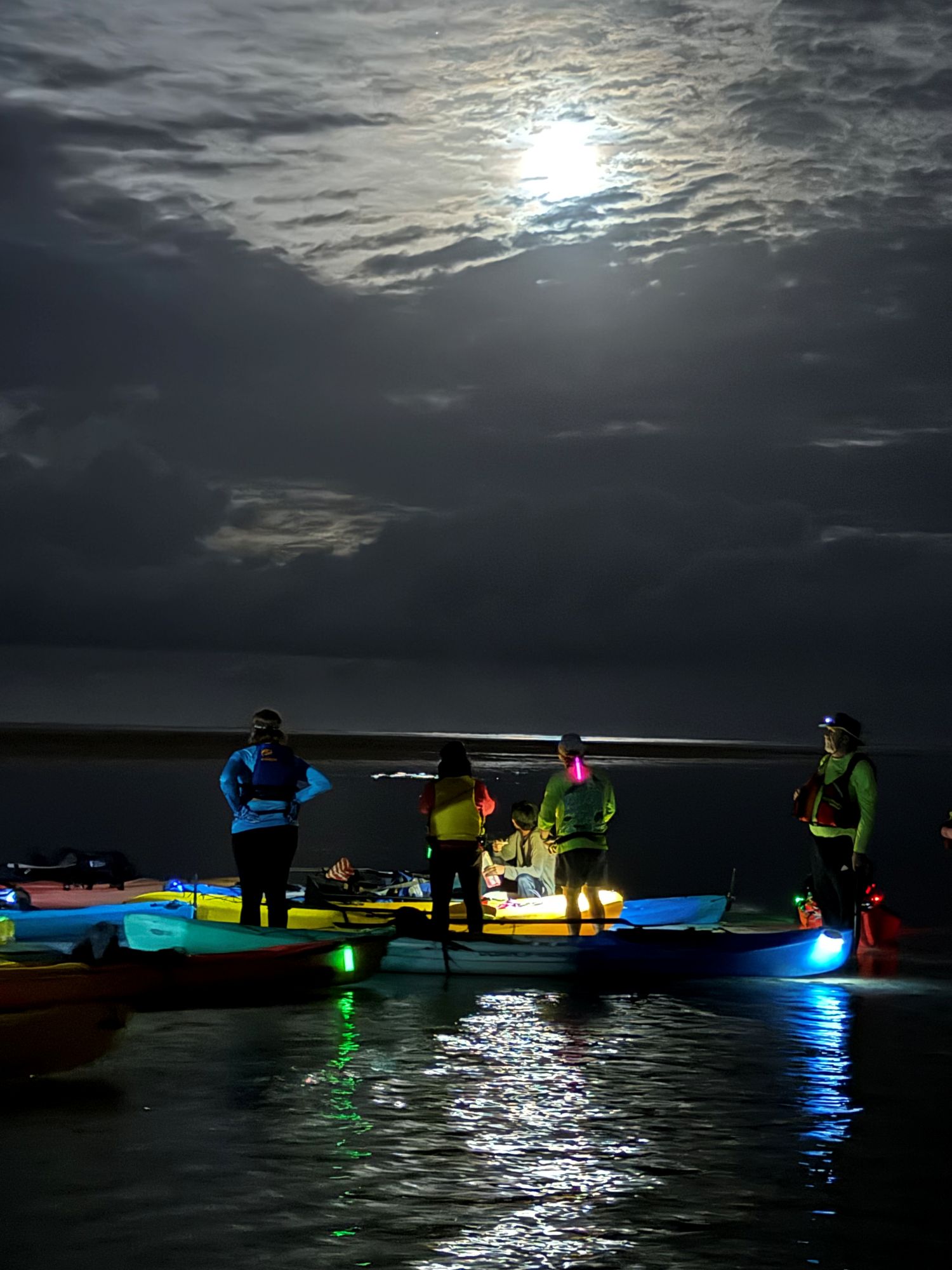
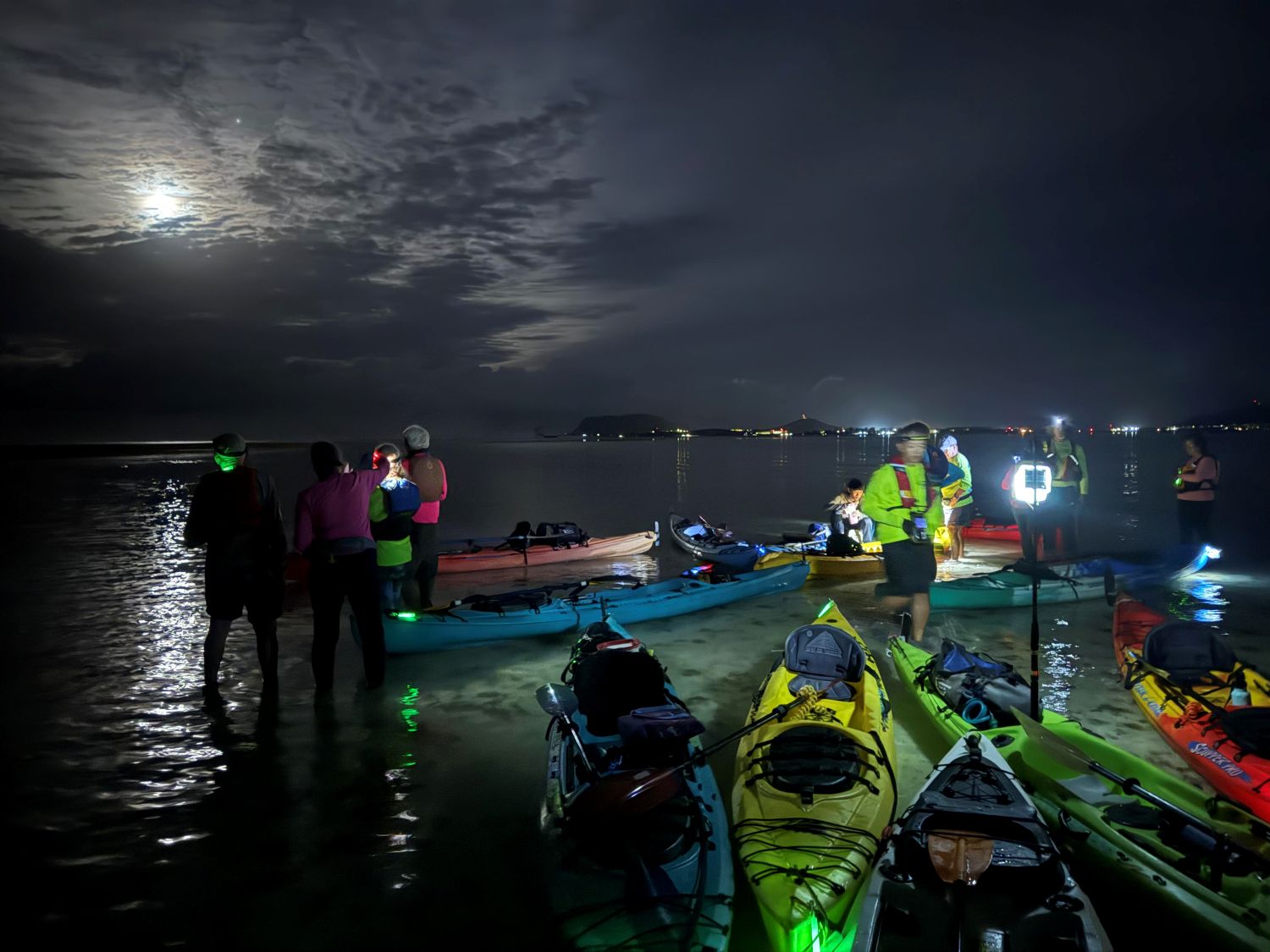
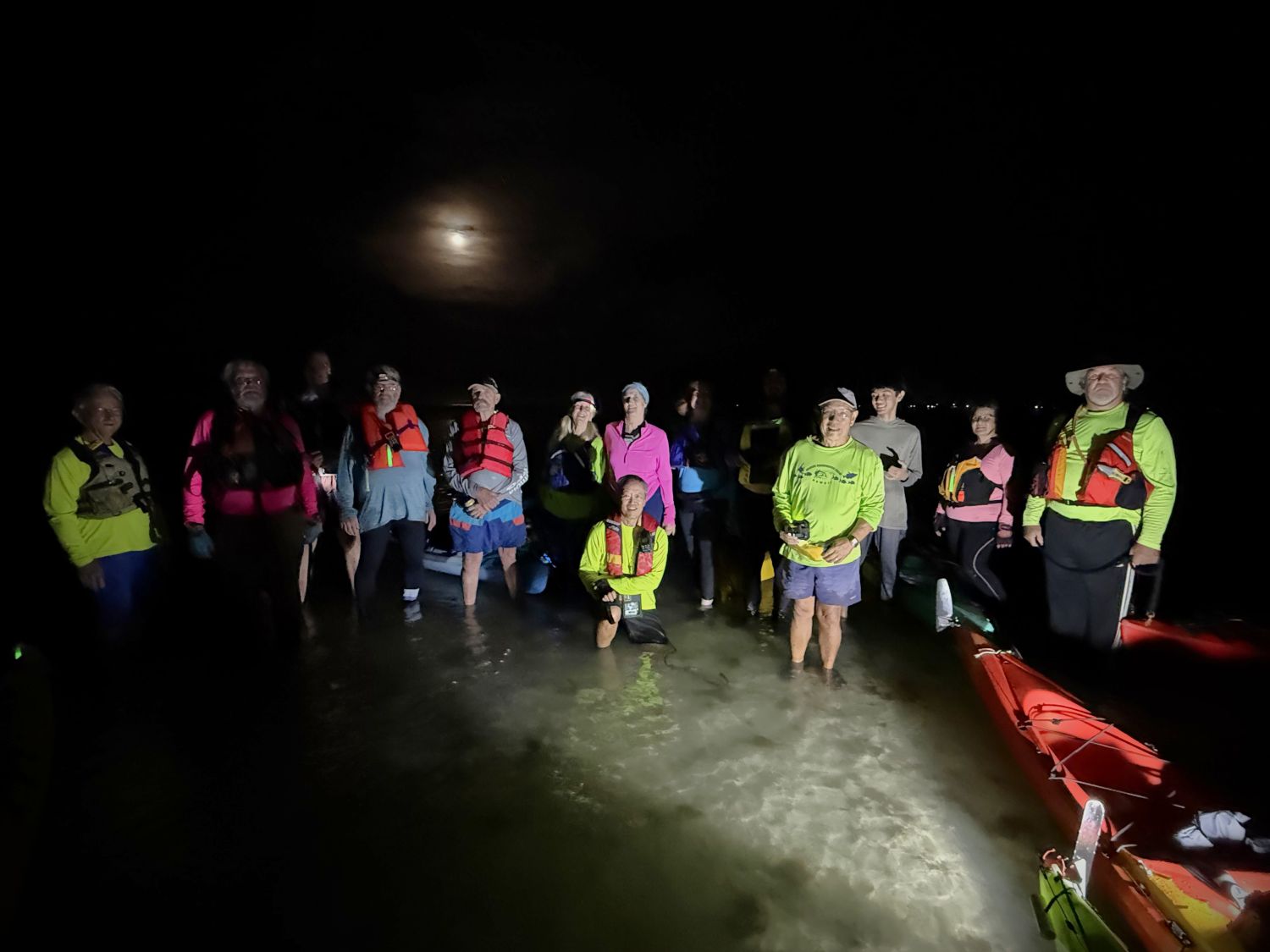
    Sixteen kayakers paddled under the supermoon to the Kāneʻohe sandbar last Saturday night. We paddled under the Wolf moon, but there was no howling on this trip.

    Before the paddle, the forecast looked bleak. But, Terry kept a close watch on the weather and, despite some cloud cover, our moonlit paddle was rain free and an easy glide across the water.

    I received a warm welcome when I arrived at the Heʻeia Kea Boat Harbor. We began with introductions and a short safety briefing. As always, Hui Waʻa members put safety first. Extra glow sticks were passed around to ensure every boat had some light. Kayaks were put in pairs and every pair had at least one radio! There would be no getting lost in the dark on this trip.

    Sixteen kayak on the beach in dim light with Mokoli'i in the background
    The flotilla ready to launch (can you find Mokoli’i?)- photo by Sandy
    Four kayakers paddling in the dark with head lamps aglow
    Head lamps shine brightly as we get underway – photo by Terry
    A few kayakers paddling in the dark with lights on. Red channel marker light is in the background.
    Heading out of the harbor – photo by Terry

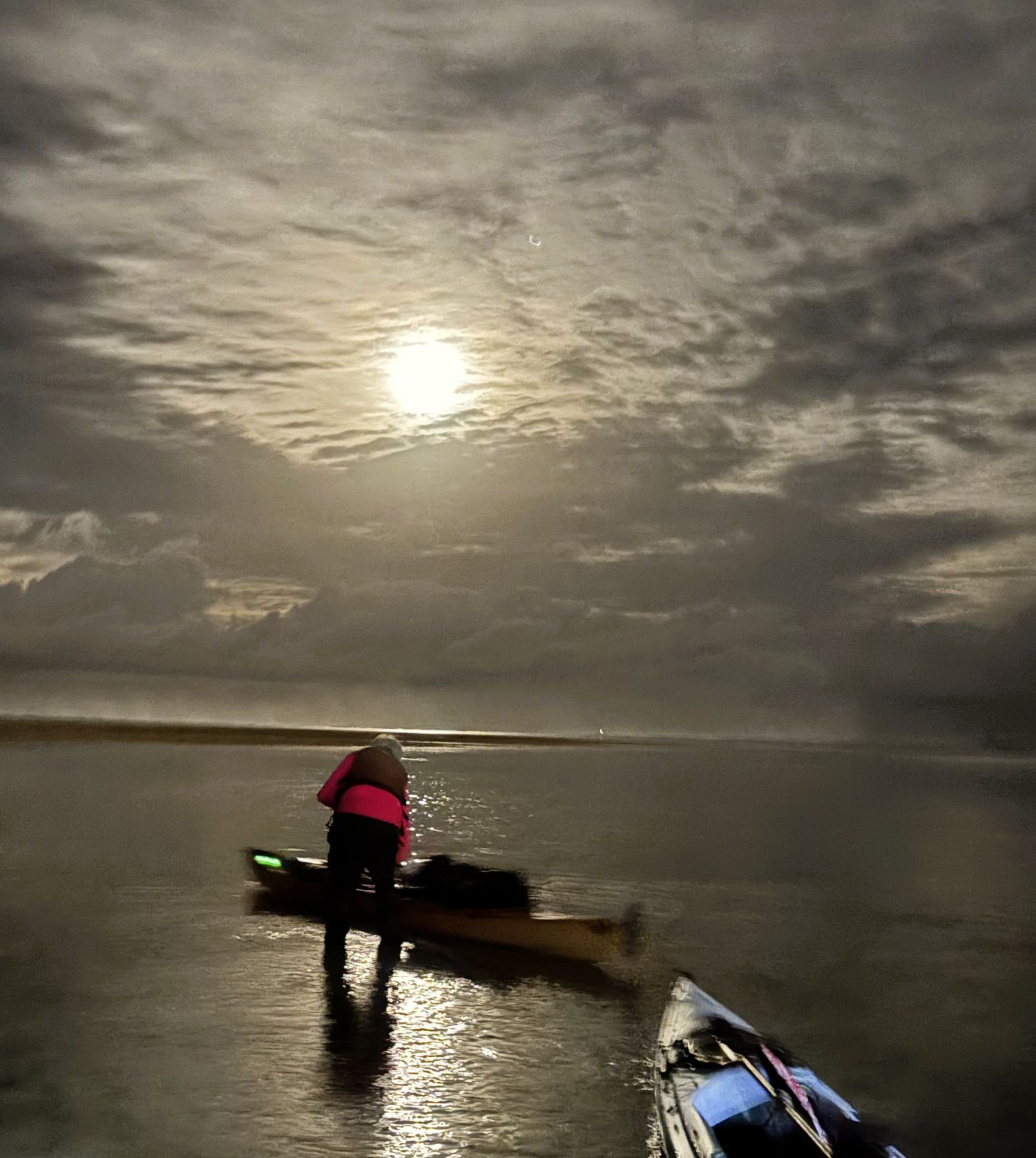
    My paddle buddy was Sandy. We had fun paddling and talking on our way to the sandbar. I learned she accomplished her goal of circumnavigating around the entire island in her kayak—a bucket list goal for me! We shared stories about our kayaking and travel adventures. Along the way, the moon played hide and seek and offered many stunning views as it peaked through the clouds.

    On our way out to the sandbar, a flashing green light helped us navigate in the dark. We gathered at the blinking light and then took a left turn to the sandbar. The way the light from the moon lit up the clouds was spectacular. But photo credits will need to go to others as I routinely neglect to take any photos myself.

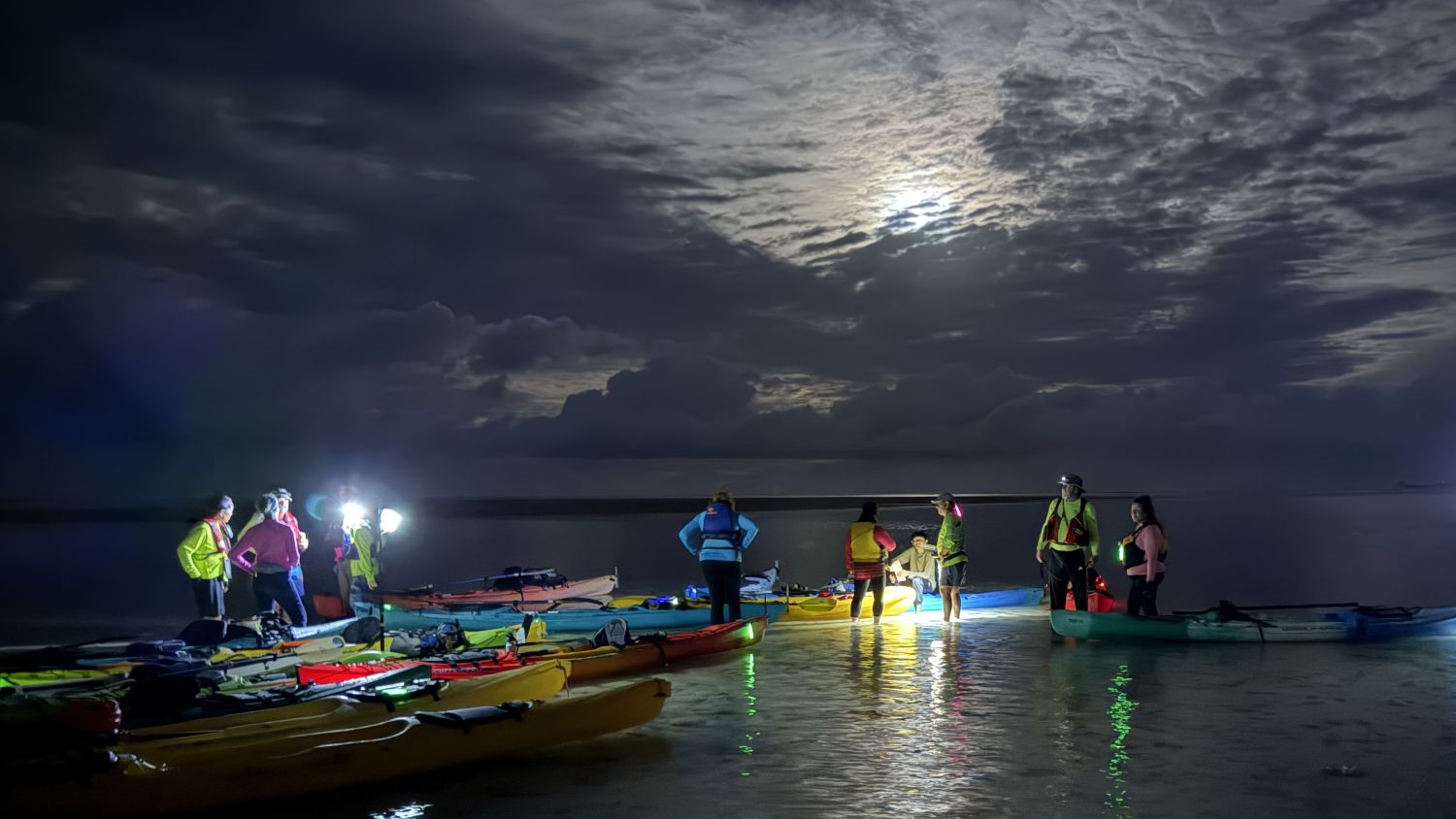
    After everyone arrived at the sandbar safely, we got out of our boats to enjoy the low tide and mingle in the moonlight. Eileen, Terry and Norm shared yummy homemade snacks with everyone. We did some moongazing and got lucky enough to see the supermoon make a full appearance from amongst the clouds. After eating and mingling, we took some fun group photos.

    Five kayakers and a number of kayaks at the sandbar with a full moon peeking through the clouds
    Mahina admirers – photo by Sandy
    Kayaks and kayakers in ankle deep water looking at the full moon
    Moon worshippers in ankle deep water – photo by Bill McK
    Full moon casts the shadow of a lone kayaker
    Denny casts a moon shadow – photo by Nikko
    Moonlight shimmers off ankle deep water at the sandbar with
    Just before mahina reveals herself – photo by Sandy

    Our paddle back to the boat harbor was similarly easy. A blinking red light guided us to shore, and all made it back safely.

    This was my second time paddling to the sandbar with the Hui Waʻa in the dark, but my first time as an official club member. Paddling under the moonlight is such a unique experience. I’m looking forward to more unique and fun kayaking adventures with the Hui Waʻa!

  • POV: Hui Waʻa Kaukahi Christmas Party 2025 by A Newbie

    POV: Hui Waʻa Kaukahi Christmas Party 2025 by A Newbie

    Story photos and videos by Nadine Owen

    December 16, 2025

    1st thought:

    Wow! These kayakers clearly know how to party on both water and land. There was no potluck sign-up sheet (that I was aware of), no continuous long email strings, no mild chaos… and yet somehow an epic, delicious, and wildly diverse spread of pupu and dinner dishes appeared. Suspiciously impressive!

    Hui Wa'a Kaukahi plague
    Plaque made by Elliott
    Assorted potluck food
    Colorful assortment of potluck food
    People serving themselves at the potluck
    Dinner time! – photo by Terry
    Diners eating around a round table
    Enjoying great kaukau and company

    2nd thought:

    Wait.. am I really standing inside the almost 100-year-old HTMC house? After 10 years and counting of hiking the various trails across the Hawaiian islands with many Meetup Hiking groups – but never worthy enough with HTMC – I felt like I’d accidentally wandered into the Royal Palace of Hiking.

    Lighted outside of the HTMC clubhouse and pavilion
    The lighted HTMC Clubhouse
    Jeanine and Nadine pose by the Christmas tree
    Another newbie, Jeanine, and the author
    Bill, Debi and Kathrin's husband, Stephen
    Bill, Debi and Stephen enjoy the festivities
    Stan D and Beth
    Beth gets Stan to smile!

    3rd thought:

    There are a lot of very happy people here who will cheerfully comply with being coerced into singing, hula-ing, doing something with only hands, and surviving a solid 5 minutes (10 if you include rehearsal and “one more run-through”) of “The Twelve Days of Christmas” local style. And the gift exchange, where you steal presents while warmly wishing the victim “Merry Christmas”, was surprisingly wholesome. It almost softened the blow of ending up with the exact gift I brought … and had been hoping to permanently evict from my house.

    Sing-a-long caroling
    The Twelve Days of Christmas Hula

    Joking aside, I was very impressed with the festive party that I heard was organized by Eileen and Nikko and truly enamored by the musical talents of Macky, Nikko, Norm and Mary Ann. Mahalo Hui Waʻa Kaukahi ohana for the warm welcome – clearly I’ve found my people!

    [Editor’s Addendum: The club recognized Joe Hu for the countless years of leadership that he has provided to the club. Chalsa gave him a nice tribute and presented him with a plaque made by Elliott.]

    Joe and Dorothy Hu with Chalsa. Joe is holding an appreciation plaque.
    Joe and his award with Dorothy and Chalsa – photo by Terry

  • Keʻehi Islets 2025

    Keʻehi Islets 2025

    Story and cover photo by Nikko Tiahrt-Conrad

    Other photos as credited

    December 7, 2025

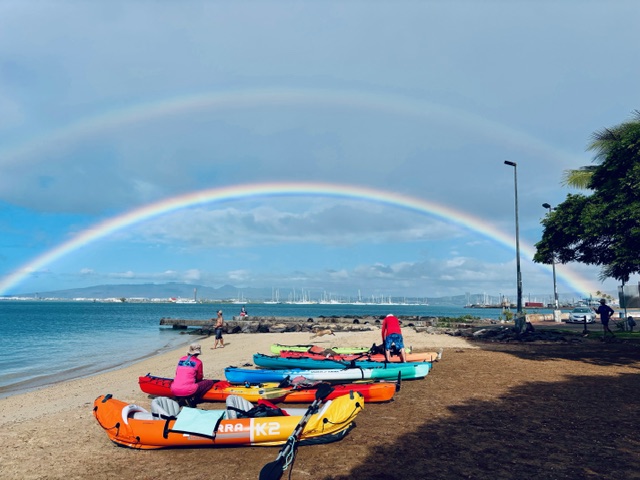
    Our paddle off Keʻehi Lagoon began with light rain yielding a double anuenue 🌈🌈as we readied our kayaks. Winds were light, no headwinds, also a good sign as the channel can be gusty. Ideal conditions for our flotilla of 16 boats to explore the islets with Sailor Steve leading the way and Stan serving as sweep. The club is well familiar with the area as it’s been the Earth Day clean up project to remove trash from the larger islet north of Mokauea, the Hawaiian fishing islet. Over the years, every third Sunday in April, we’d haul off debris that got trapped in the mangrove and kiawe brambles. This work detail was not for the faint of heart thin skinned as the kiawe thorns were thick and pierce through shoes. Since the airport has taken the lead to clean the invasives as a way to deter birds from the flight path these islets appear to be reclaimed by the tide and rising sea level.

    In May of this year Honolulu City Council passed a resolution to urge the Hawaiian State Board of Geographic Names to officially restore the name of Sand Island to it’s Hawaiian origin Mauliola, meaning “breath of life” or “power of healing”. While not digressing too much on the history of the area it is important to note the tenacity of the Hawaiian fishermen families on Mokauea. They are preserving the island fish pond, that is the last in the area that had at one time 20. King Kamehameha lll designated it a protected royal fishing area in 1830, these handful of homes off the grid maintain a way of life in the face of planes overhead.

    The paddle went around the islets and to the end of the runway. We stopped for a break to snack and stretch watching the rain moving across the coast. The tide was receding so we had a shallow paddle (rudders up) on some of the way back. Some chose to walk their boats. It was a good one that the wind did not pick up as this paddle back in headwind can be tiring. For our first paddle back in Hawaii after several months away it was an easy re-entry. Good to see familiar faces and meet new ones. Good to see Mokauea is maintaining its traditions while smaller islets remain clear of invasives. Doubly so! 🌈🌈

  • Kaʻena Point Leeward Coast

    Kaʻena Point Leeward Coast

    Story and photos by Terry Shimabukuro

    October 12, 2025

    Kayaking from Mokulēʻia to Keawaʻula Bay around Kaʻena Point treats paddlers to vistas of a windswept mountain ridge, seabirds soaring above a protected coastal plain, waves crashing against a rocky shore and if you’re lucky sightings of large honu, a cruising pod of naiʻa, a curious ‘īlioholoikauaua (“Dog that runs in rough water”, Hawaiian monk seal) or, if you’re really lucky, a splashing koholā. As awesome as this sounds, paddling this route involves planning a long, arduous carpool and careful monitoring of wind and wave forecasts to avoid dangerous conditions. Stan, a diligent paddle leader, pondered these factors for a week and decided to play it safe and switched to a round trip from Mākua to the point and back, no carpool required. 

    This switch prompted several more carpool adverse paddlers to sign up, including myself. A half-dozen kayakers showed up. Even though I live the closest I was the last to show up as everyone else got there early and were almost ready to launch. I scrambled to get ready as the others studied the small shore break. The conditions looked great so everyone was eager to go.

    Stan held a brief Captain’s meeting. Steve heard an ulua calling his name so he charged out…right into a small set. He gave a great demonstration on how to wait out a set while keeping control of your kayak. This was Amy’s first shore break launch and she timed her launch much better. 

    I followed Stan out and after clearing the swells I looked up to see several dorsal fins silently arcing out of the water. I was surrounded by a large naiʻa pod! I radioed the group, who were already paddling west, about the dolphins, but I didn’t know they had been watching them from shore and had seen enough by the time I launched. So, I sat idle, by myself, enjoying the acrobatic show of the playful keiki until the pod moved on. (Watch the video on YouTube if you’re not getting good resolution)

    We made good time paddling out to the point with calm water and light variable wind. I opted to stay close to shore with Stan to get a good look at the rugged shoreline. The gentle swell allowed us to get up close. At several places I thought I saw arches that I didn’t remember from hiking the coast. As I paddled past I was disappointed that they were just illusions of light and shadows that made them appear as arches from a certain angle. When I reached the big arch that everyone sees from the hiking trail I was skeptical that it was the same one. Looking at my photo afterward I was happy to see that it wasn’t an illusion.

    I spotted a white plastic jug bobbing on the surface and went to collect it as any good ocean steward would. I couldn’t simply pluck it from the water, however, as it was securely anchored in place with over a 100-pound test monofilament line. I gave it a few good tugs hoping to break the line close to its anchor, but it’s hard to generate enough force when you’re just floating in a kayak. I cut the jug free, retrieving it plus a couple hundred yards of braided fishing line. It must have been in the water for a while judging by the amount of flotsam tangled up in it. 

    I wish the state would ban this type of fishing as having this much submerged line is a danger to marine life and boaters that can get it tangled in their propellers. Earlier this year a young monk seal died after becoming entangled in a similar jug rig. This is the second time that I’ve pulled up a mess like this. The first time, I helped Sandy who ran into the fishing line with her paddle. That time, a large honu popped up behind Sandy as we were retrieving the line as if to say mahalo. This time, three large honus surfaced after I finished. (I didn’t get a photo, you’ll just have to take my word for it.) Whenever you’re paddling, if you see a jug floating on the water take the time to pick it up and if it has fishing line attached to it check to see it a fisherman is still attached to the other end. If not, retrieve as much of the line as you safely can. A honu may thank you too.

    As many times that I’ve paddled and hiked this coast it was my first time truly appreciating the scale of the old Oʻahu Railway foundation. Stan said that those foundation rocks were all manually placed. Impressive, they survived over 100 years of erosion from storms and pounding surf.

    I rendezvoused with Amy, Kelvin and Stan at the point. We took a break to soak up the breathtaking scenery and surmised that we could probably paddle to Mokuleʻia with the conditions that day. I herded them together for a group photo.

    As we began the return journey, we realized that the current has carried us a long way from the point. We felt it too, as it was slow going to get back to the point. I looked at my GPS track after the paddle and we had drifted almost a mile beyond the point! Maybe not the best place to take a long break unless your destination is Kauai.

    We managed to get spread out far apart on the return leg. Our unintended separation demonstrated the value of everyone having working VHF radios as we were able to keep track of each other and ensure that the less experienced kayakers returned safely. Congratulations to Amy for completing her first long distance paddle and to Kelvin who made it back unassisted even though he was running on empty! Mahalo to Stan for making the switch to a round trip so that more of us could experience this incredible journey!